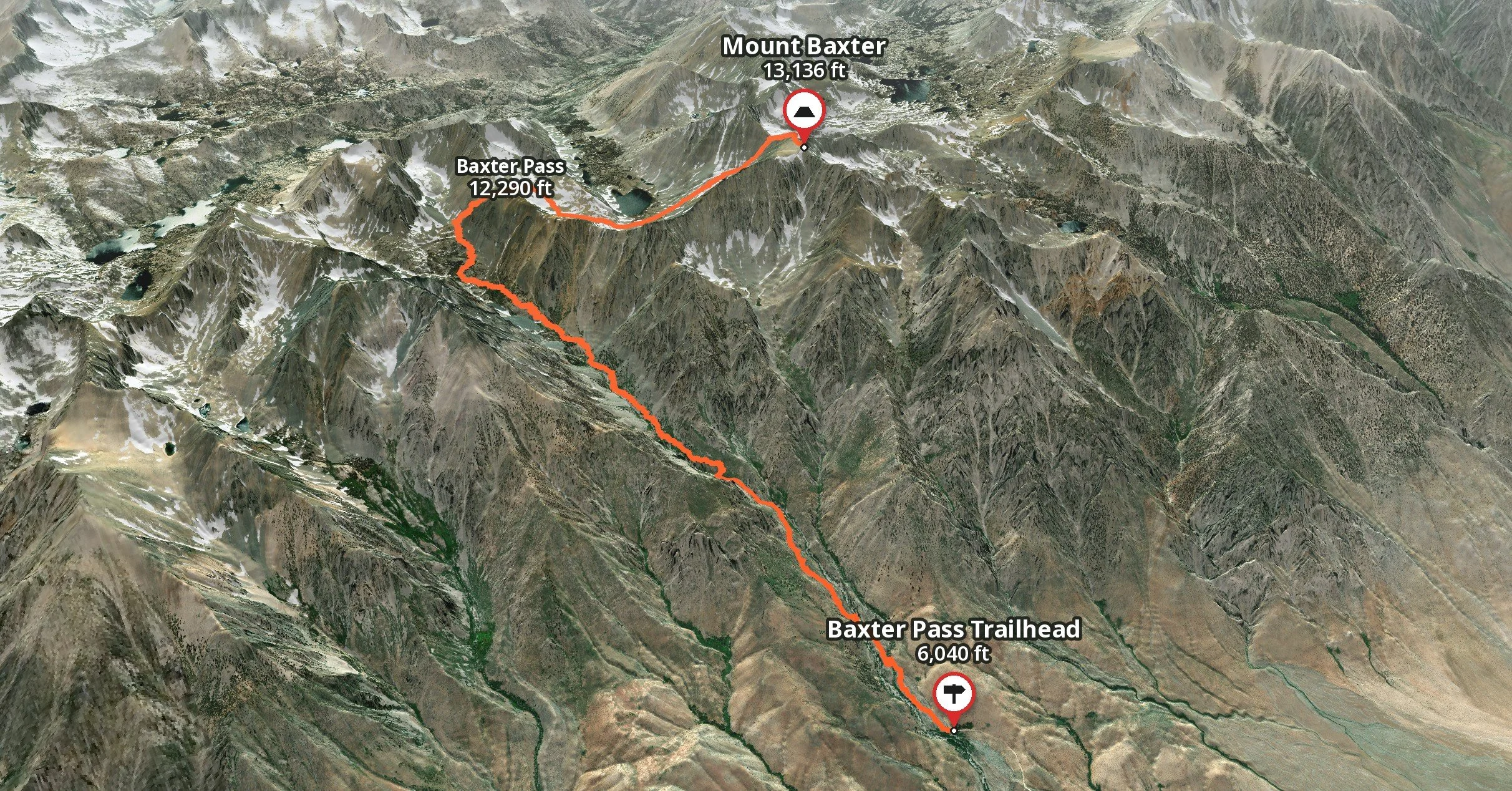
Mount Baxter, Sierra Nevada (SPS)
BAXTER PASS TRAIL
While Baxter Pass is beautiful, as are most of the Sierra Nevada’s high mountain passes, its trail leaves something to be desired. The Baxter Pass Trail could generously be called a pain—and yes, it’s hard to malign any trail of the Sierra after sampling the post-apocalyptic wreckage of Wilshire Blvd. or modern day Haight St. Still, there is a distinctly hostile element.
To begin with, the trailhead is among the Eastern Sierra’s lowest, so any romp of its snowy heights must begin with its arid depths. While enduring the flat heat of the sagebrush belt—that transition zone between the low desert and the more tolerable subalpine—may in the end prove spiritually rewarding, it is by no means undemanding.
Prickly pear and Mojave buckwheat liven the canyon’s mouth, luring the unwitting hiker toward the chaos of Oak Creek. Here three distinct wash-outs conspire to obscure the trail to all but the most competent of psychics. Downed trees and glutted channels force the hiker through clumps of whitethorn and dense patches of fern, beneath which reside all manner of proboscis-wielding demon. Ultimately, a series of water crossings will test the mettle of all who traverse them, the last of which churns across a particularly deep trench into which your humble author took a uniquely humbling spill.
But, as with any worthwhile challenge, the trail rewards displays of fortitude. Soon the path comes out of hiding, the air freshens with altitude, and the weary hiker may at last unsling their pack and find a suitable spot for basecamp.
To do so, they must choose between the true Summit Meadow and its falsely-marked counterpart. For the purposes of this guide, I will refer to the imposter as “Some Meadow” (you can see already which I favor.) I suppose that “Some Meadow” could imply a certain 1950’s-era enthusiasm (as in “That sure was some rhubarb pie, Luanne!”) but is in fact meant in the pejorative, as in “some guy” or “some nondescript thicket.” Which indeed it is.
I will say this in defense of Some Meadow, however: it is a mile nearer the trailhead, and so will save you an additional thousand feet of climbing. After four-thousand feet of unmitigated effort, this can be quite the selling point. In all fairness, Some Meadow is a perfectly serviceable resting place. It sits at just under 10,000 ft. and so is subject to the typical opulence of the High Sierra: tangerine sunsets on White balsam; secret bursts of mountain heather; the wash and fold of minor currents beneath an affluence of stars.
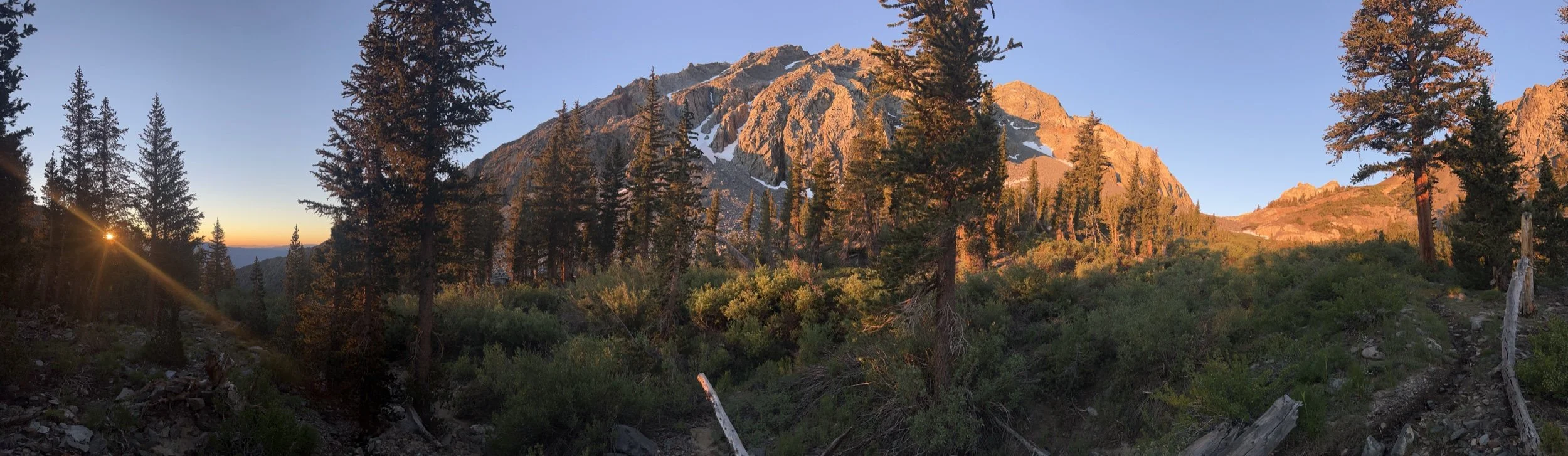
And yet, in spite of all its charm, Some Meadow simply pales beside the beauty of the true Summit Meadow. Persist a mile farther and see for yourself: a sanctuary of untrimmed earth enclosed by juniper and black sage, the froth of Oak Creek fringed by fawn lilies and wild onions, green in the verges. Here the backpacker can tromp freely (unlike many of the Sierra’s more prominent meadows) without feeling they have trespassed some sacred threshold. Why this is exactly, I cannot say. It may be that the foliage is more robust and seems to welcome the boot and tent stake. Or the margin between forest and softer grasses remains unclear.
Regardless, Summit Meadow is ideally situated to serve as basecamp for climbs of the nearby peaks. Or, for those whose tolerance for discomfort is not so comically excessive, it is a perfectly reasonable destination in its own right.
MOUNT BAXTER
Here we have the main event: Mount Baxter, whose name defines the region and so evokes all the jagged hostility of a renowned Sierran summit. One imagines an embattled fortress of rock, vengeful spires and slick escarpments. Yet nothing could be further from the truth. In fact, neither the mountain nor the man whose name it bears—John Baxter, a simple Owens Valley rancher who just so happened to have been companionable enough to house and feed a hungry band of roving mountaineers—is anything so awful.
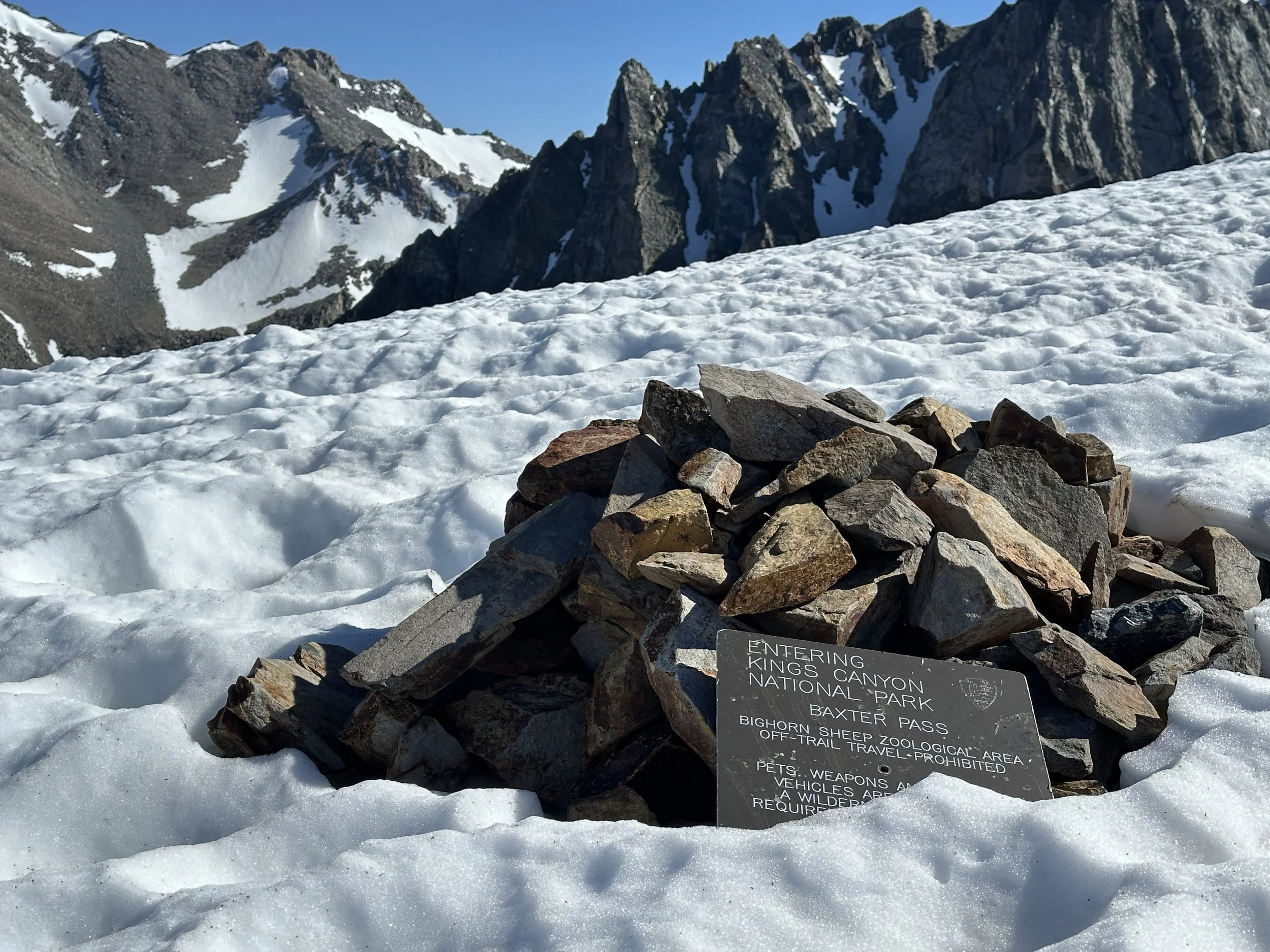
From the moment you crest the spine of Baxter Pass it becomes apparent that Baxter Mountain is neither the most imposing nor even the largest peak in the vicinity. Gazing behind you, Diamond Peak looks downright terrifying, and the broad footprint of Mount Mary Austin looks much as it has for the entirety of the journey, which is to say tremendous.
By comparison, Baxter Mountain is gentle and without pretense. It lifts softly from its high basin without any sign of malice. Though much of its talus is of the overexcited variety, shifting about beneath you in a spirit of agitation, the mountain on the whole is quite hospitable. Grasshopper Pass offers a welcome reprieve midway up the eastern face, and the summit itself forms a strip broad enough to function as a runway. Here climbers can bask in the warmth of their exertion and enjoy views down on the deep flat of Owens Valley. Also noteworthy is the upraised spike of Mount Clarence King, which from this vantage looks sculpted by Satan himself, poised to impale any young climber foolish enough to stray atop it.
You’ll have to forgive me for sounding a bit cliché, but in reflecting on Baxter Mountain, the journey really does outshine the destination. After trundling up the short steep mile from Summit Meadow to the pinched rock of Baxter Pass, a fresh world opens beneath you. While the notched rim arcing northward, with its black and ocher hues, is reminiscent of Tolkien’s Mordor, the basin it encloses is a veritable Eden. Plush flora and plentiful water make for idyllic walking. Baxter Lake appears sudden and bottomless, skirting the horizon in the style of resort infinity pools.
In all, it is the perfect spot to lunch at. Or nap at. Or for any invented reason to loaf about in a sun-baked torpor. To my mind, it is entirely appropriate for a climber to arrive at the basin and promptly gorge themselves on sugared snacks, pamper themselves with frosty water, then assume a prone position and imitate as best they can a happily beached whale. Moreover, it is good form. Considering for a moment that the reward for effort is fatigue, why squander such rich exhaustion on a setting any less exquisite?
Total Distance: 19 miles
Elevation Gain: 9,500 ft