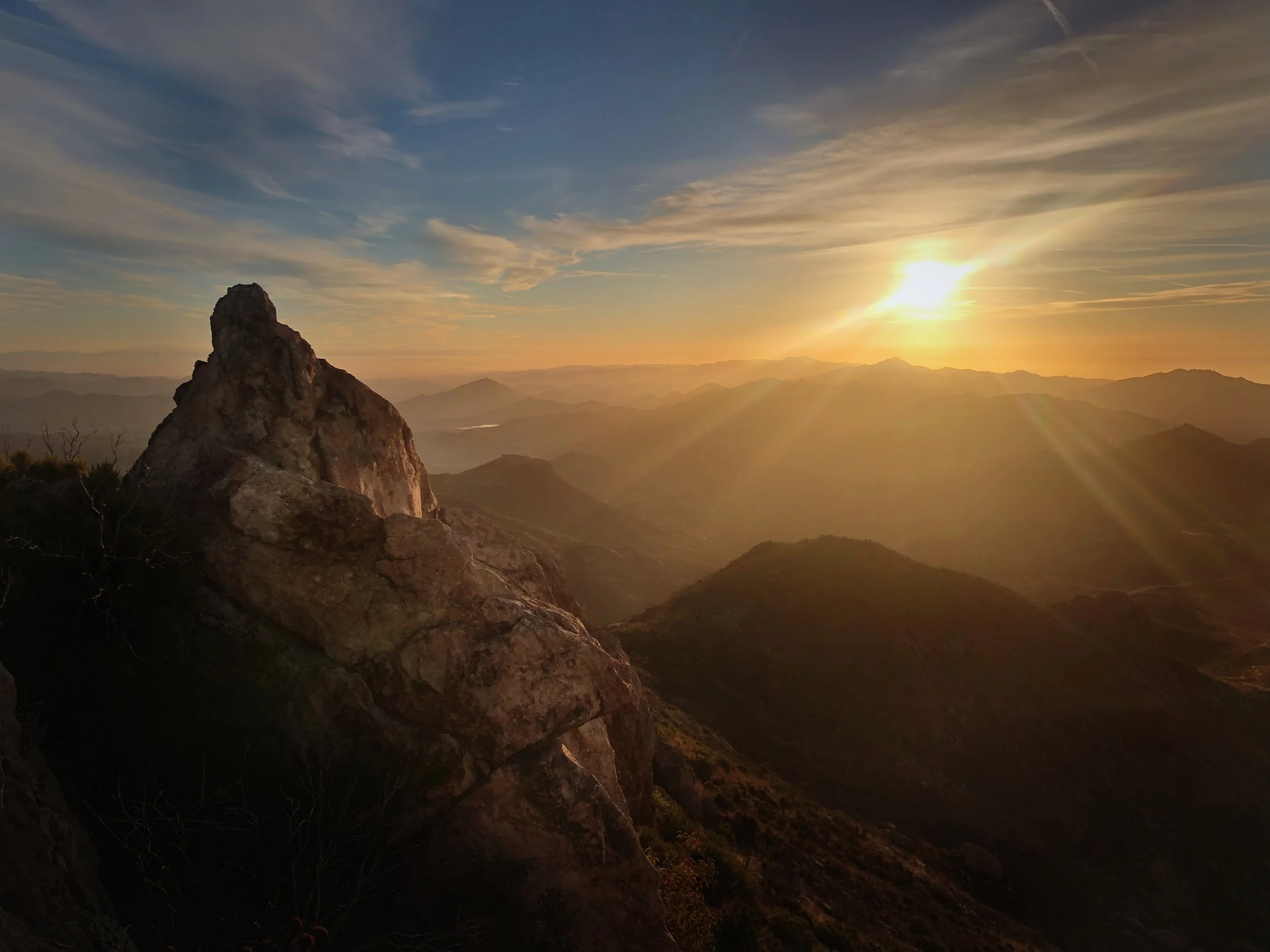
Tri Peaks
Scrambling in the Santa Monica Mountains
Click to read at Backpacking Light Magazine
“There’s no altitude here,” I complain to my friend. He grunts some mild form of agreement, mostly out of politeness. Rob is a professional climber and teaches at a gym in Rancho Cucamonga. For him, altitude in one form or another is a prerequisite for daily life.
We met on the Devil’s Backbone near the summit of Mt. Baldy, a stretch of trail notorious for consuming greenhorn hikers. It hugged the ridgeline, boasting 2,000 ft drops to either side. The bolt anchors fixed along the trail did nothing to ease my nerves.
Rob had approached me from behind, lean and sinewy as a mountain goat and very nearly as agile. In his sixties, he had somehow bypassed the tedium of aging. Rob lived in Azusa for the express purpose of summiting Baldy twice a week. His students found this admirable. I found it flat insane.
No wonder then my protest as to accessible altitude fell on deaf ears. At any given moment Rob was likely strapping on a harness and crampons. For me “accessible” meant carefully marked trailheads, bluebird skies and a chance of rain considerably below 20%. Having grown up in Southern California, where heavy weather meant thick smog, snow was not part of my repertoire.
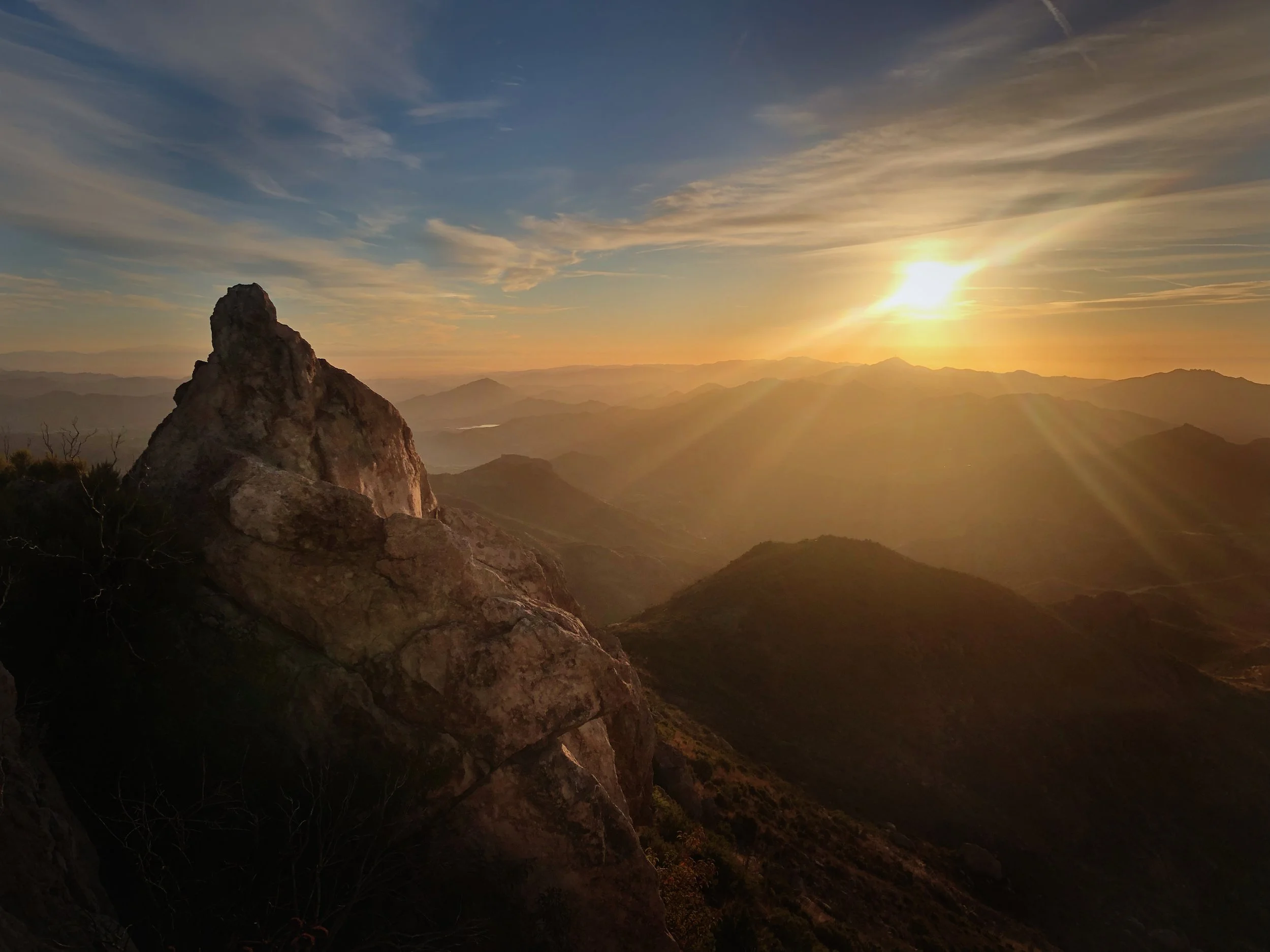
Sunrise over sandstone
Yet following a summer season which saw me tromping the Sierras with daily gains in excess of 5,000 ft. and distances surpassing 20 miles, the casual day hike over cooperative terrain sounded a bit, well, pedestrian. I had fostered a strong-willed dependency on altitude. Maybe it was the pleasant tingle of oxygen deprivation, not unlike a double shot of vodka before it hits. I was managing withdrawal from the trail poorly, guilty of certain lapses. I had cold-soaked trail food in my kitchen out of desperate nostalgia and taken to wearing my Altras, replete with gaiters, about town. Each morning I awoke to break down camp at 4am only to discover myself confined to the abundance of a California King. I had not yet stooped to the marital death-knell of a sleeping bag laid at the bedside, but I could not be very far from it.
I rise early on a Wednesday, and as the thought is first materializing I am already cramming my pack with water and health bars and instant coffee packets. I am out the door and in the car before the notion fully surfaces, Maybe I should try a day hike… Yes, it’s true that I looked down on them as nouveau riche for transit busses, but I had also heard that legendary mountain athlete Kilian Jornet had run 56 hours out the front door of his house. He did this along the high spine that links the local fjords of Norway in a practice known delightfully as “skyrunning.”
I set out to achieve a poor man’s imitation and find the Pacific Coast Highway oddly tolerable at 5am, lacking its daily droves of surfers who vault across four lanes of traffic to catch either a wave or fender. Hang a right on Yerba Buena, just after Neptune’s Net, and it’s twenty minutes up the mountain to the Mishe Mokwa trailhead. I have been told Mishe Mokwa means “white man’s trail” in the Chumash language and, contrastingly, that Mishe Mokwa was a great bear in Chippewan tribal mythology. Both these explanations were furnished by outspoken white men. I have yet to ask the bears about it.
By the bright glare of my headlamp I take a first glance at the map. My aim is to string together a series of peaks by footprint. I see them listed one after the next, as specials on a menu: Sandstone Peak, Bony Peak, Exchange Peak, Tri Peaks, Big Dome… Admittedly, I’ve done no research to ensure they do in fact exist or are indeed worth the effort, but I’m too joyful to be bothered. For the first time since winter barred me from the Sierra I am back in pre-dawn darkness. My titanium cold-soak jar bears a sludge of varied grains which tastes mildly repulsive and fills me with fibrous pleasure. The sun lifts slowly to paint the sandstone. The landscape here, flushed red and rumpled, would not be out of place either in Sedona or a post-terraformed Mars.
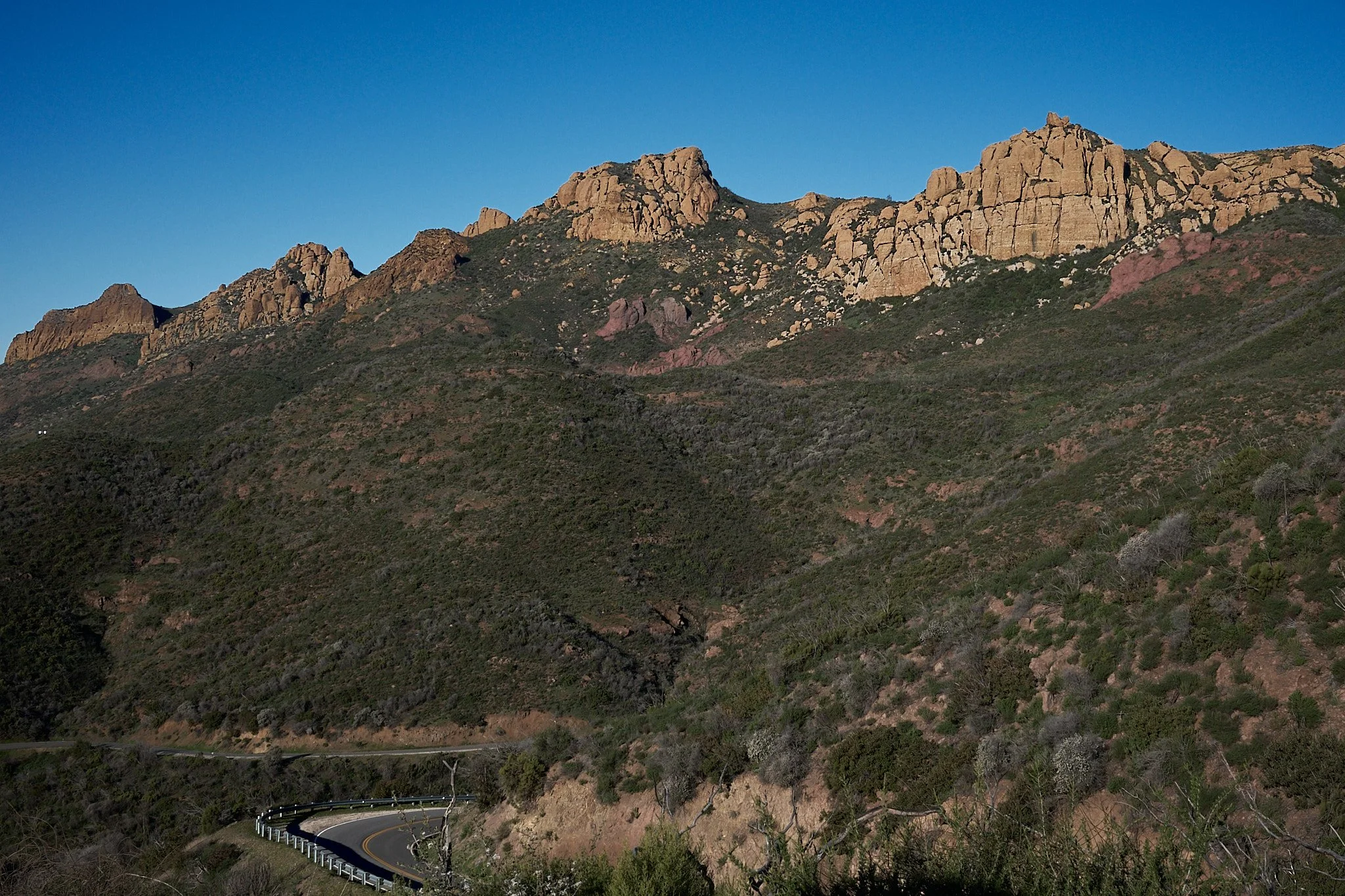
Red rocks and empty roads.
Sandstone Peak proves to be an uncomplicated uphill jaunt. It is the highest point in the Santa Monica Mountains, which is much like saying Moe was the smartest of the Stooges. It is also called Mount Allen, enjoying dual title much as Mt. Baldy does as Mt. San Antonio.
Boney Peak (which upholds this tradition, known also as Boney Mountain) is perhaps the most loved of the bunch. It is a longstanding holy site of the Chumash Native Americans, and out of respect I circumvent it. That and I completely miss the turnoff.
Adjacent Bony Peak stands Inspiration Point, a place no more or less inspiring than any of the countless outcrops the trail has already provided. It vies for hikers’ attention by sporting an oversized and tarnished compass set into its crest onto which passersby set their loose change. This is either for good luck or because our currency is digital.
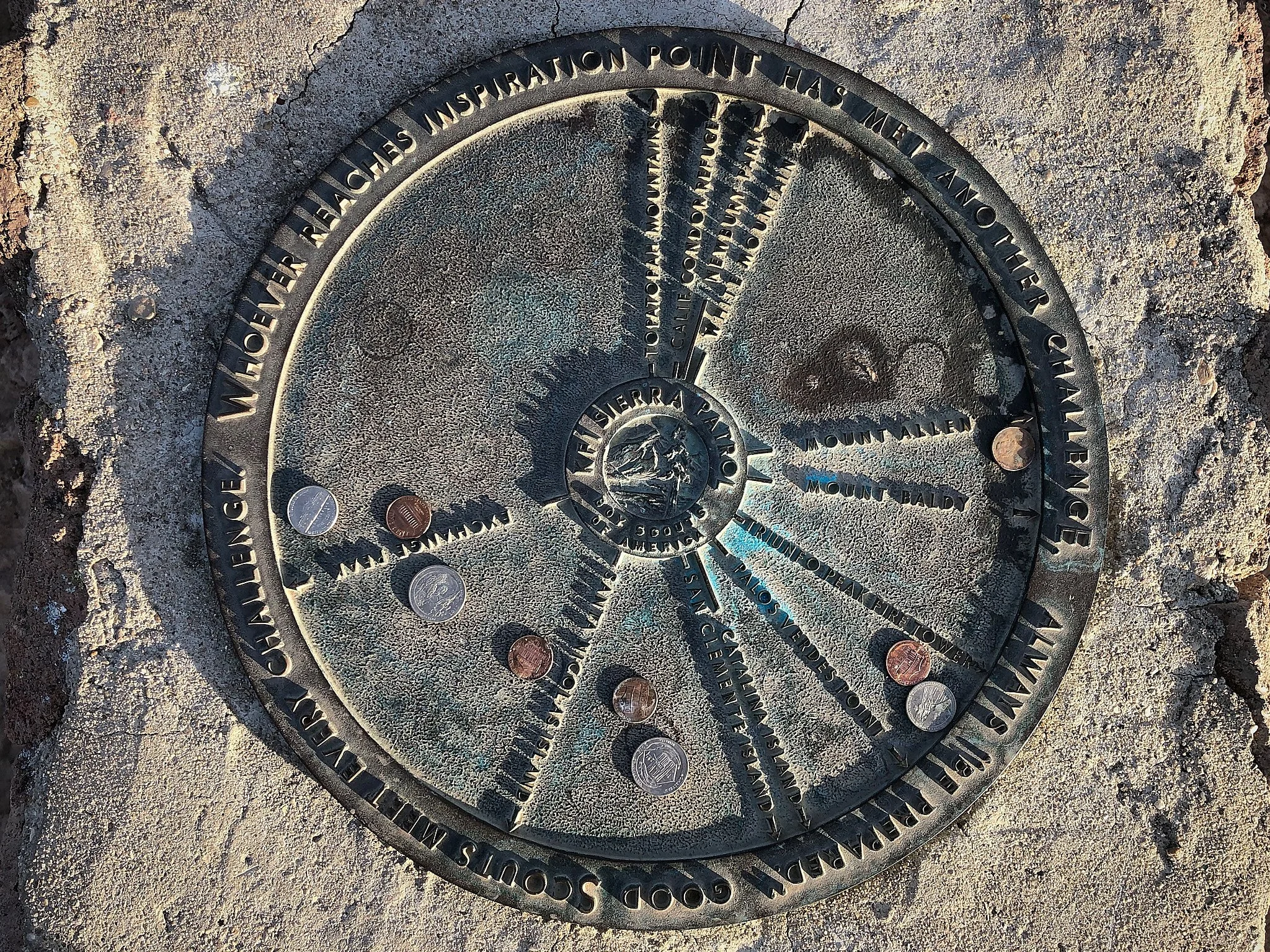
Coin of a bygone era.
Next up, Exchange Peak. A sprawl of use trails stymies the hesitant explorer. One must simply attack the mountain, bushwhacking through a veritable cheese grater of undergrowth. Trending west will help avoid the sheer eastern face, which is a challenge best suited those with a high tolerance for falling. On summiting the prominence (from the west) a celebration is in order. I suggest the newfound mountaineer indulge in some variety of nut bar. This pairs nicely with a sports drink packet of the raspberry varietal.
Then comes the long slog through a gravelly wash during which I convince myself I am undoubtedly off-trail. I am not, of course, but in seeking out the trail I promptly lose it. The sun reaches its zenith and a parfait is in order. I have not packed a parfait, of course, nor a cold beer, nor chocolate ice cream. A central feature of desert hiking is the craving for cold food. I have heard rumor of an ancient Chumash village excavated in these parts, and as I maunder about I wonder if it might have a soda fountain.
I fail to find the village, but by luck alone I stumble on a signpost for the trail. It is here that the distinction between trail and wilderness becomes purely theoretical. I scramble up dusty slopes that show no reasonable adherence to the green line on my map and am often reduced to waving my GPS around as a divining rod. I commit myself to trail ducks, which are sort of micro-cairns; neat little heaps of balanced rocks meant to orient the hapless wanderer, placed by others who were presumably at least somewhat less lost themselves (although the false duck is not unheard of.)
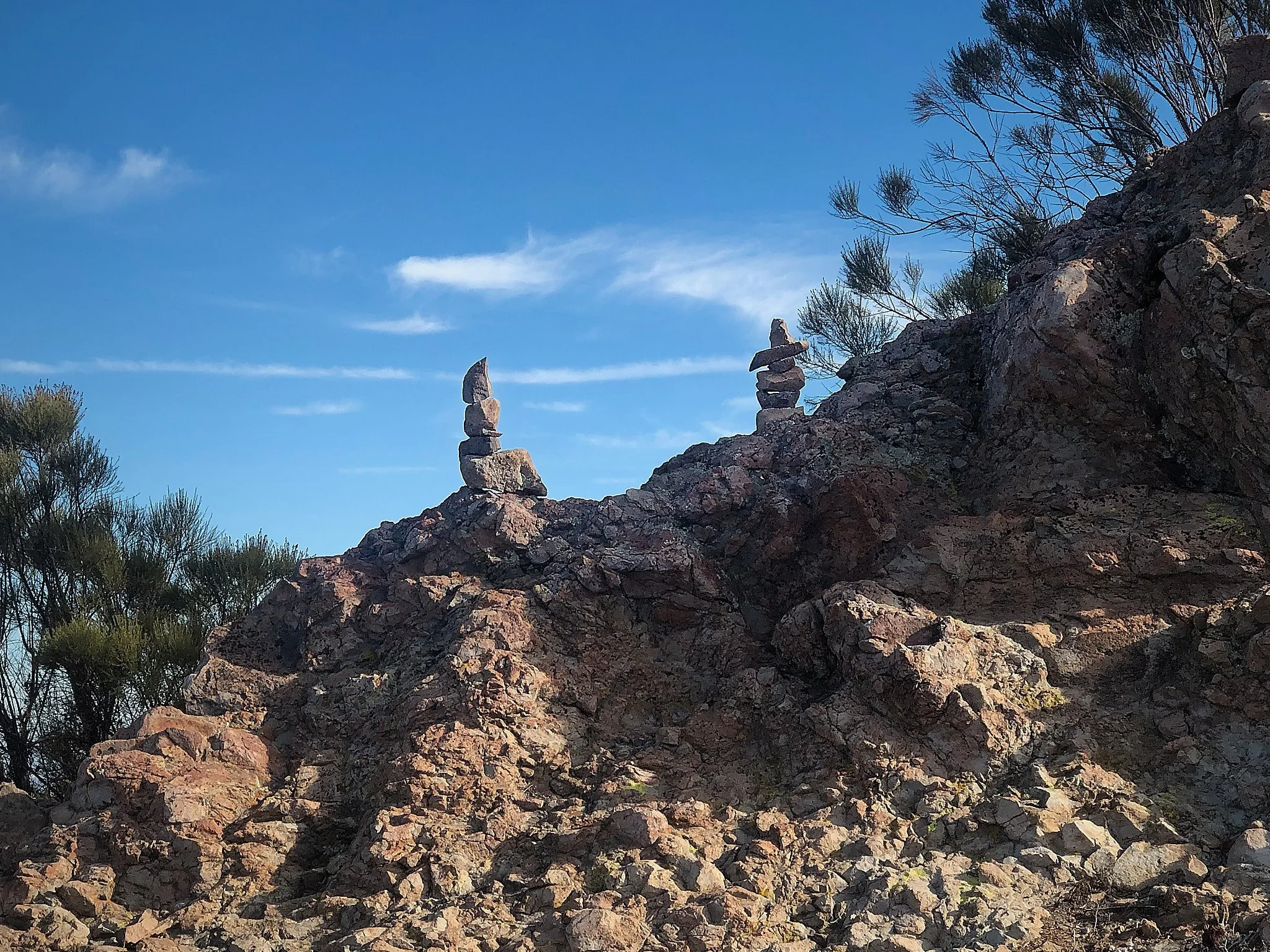
Ducks of questionable provenance.
I end up following these trail ducks to a bladed cusp of sandstone. If this is indeed the trail, the word itself is worthless. I note with trepidation the exposure now beneath me. I’m not gambling with my life just yet, but certainly my ankles. A fall would flinder them to kindling. In Sierra-talk, Class 2.5.
At this point, while considering a tumble down the mountain, I realize I do not miss the High Sierra whatsoever. Just as Kilian did not miss the Matterhorn (which he ran) or Kilimanjaro (which he ran) or Everest (…you get the picture) while traipsing along his local ridgeline. It is the old adage of the young prospector who sails around the globe only to happen on the goldmine buried just beneath his home.
My treasure, it becomes apparent, will be at best a golden leg splint. I am lowering myself down jagged chutes and narrow rifts. I toss my pack beneath me at each drop to test the distance. My thinking is if the pack explodes to dust on impact, maybe I shouldn’t follow.
By slides and tumbles and falling backpacks I round the north face of Tri Peaks where finally my course bears eastward and the terrain loses its malice. I reconnect with Mishe Mokwa and begin a long and lovely section of extravagantly maintained trail. Now this is proper trail, thoughtless trail, steady and even, where one can ease into a rhythm and lose themself to time completely. Until now the course entailed a degree of constant vigilance. By comparison, Mishe Mokwa is no more demanding than a couch.
I trace a scenic gully and enjoy the long-tufted pipestems that fringe the trail. They seem to nod shaggy agreement, though are ruthless if ingested. Proud foxtail and budding anise make select appearances, but the main show is the sandstone. I pass Split Rock and Balance Rock which, not to be accused of false advertisement, are exactly as expected: a massive chunk riven in thirds, another roosted on a crag. The trail gains some, then descends, intersecting with the Backbone, and a brisk 300 ft. of downhill returns me to the trailhead.
Five hours. A pleasant morning passed in local mountains. Do I recommend it? Sure I do.
If you can’t get to the Sierra.

About the Author
A writer by trade, Isaac Simons is a longtime lover of outdoor exploration and has devoted himself increasingly to introducing as many people as possible to the challenges and rewards of the backcountry. His writing has appeared in Storgy Magazine, Centipede Press and Viewfinder Magazine, among others, with pieces forthcoming in Summit Journal and LOST. Most recently, Isaac launched Outroads, a video podcast about uncommon obsessions, unconventional life choices, and the lessons gleaned from them.