Matterhorn Peak
and Other Long Shots
Originally appeared in The Sierra Echo, Vol. 69 No. 2, April–June 2025 (pp. 22–25)
Aspirations ran high, comically so.
It was somewhere between my fourth and fifth career (but who was counting?) that I, being chronically beerdrunk and heartsick, not to mention mildly anxious, decided to commit myself fully to the mountains. I had amassed a tepid resume of weeklong hikes, cross-country peaks, Class 2-3 scrambles, and the most tentative of outdoor rock climbs, all of which qualified me for nothing more than the further development of each.
Still, I was not one to waver once fixed on an objective. My spirit animal was the bulldog, and it had rightly been said of me that I dealt solely in obsessions, that in the vault where I stockpiled them there remained no room for casual interests. On the plus side, this sort of myopia lent itself wondrously to wilderness pursuits. I knew this from reading deeply of my predecessors—Ernest Shackleton, Nan Shepherd, and Colin Fletcher, to name a few. Men and women whose passion for exploration ran as deep as it did desperate.
In a fit of spirited compulsion (one I imagined John Muir himself would have been proud of) I committed to join a small group for a climb of Yosemite’s austere Matterhorn Peak. No mean undertaking in the best of conditions, but now, in mid-December, with the High Sierra packed in ice as though for transport, the odds of summiting were marginal.
The expedition was set to commence the following morning, and I stumbled aimlessly around Mammoth Lakes while waiting for its restaurants to open. Already numb with cold, I passed the odd half-hour hunkered beside a decorative fireplace in an upscale hotel’s outdoor garden. This not only attracted curious looks from within the lobby but also did much to stave off hypothermia. It would be poor form, I decided, to begin the climb with frostbite.
It was at this point, while pummeling my legs to regain feeling, that I began to question the wisdom of my decision. There were plenty of far simpler and less expensive ways to humiliate myself than going through all the trouble of purchasing a zero-degree sleeping bag, a heavy-duty winter parka, packing three days worth of rations, bidding my wife and daughter a dramatic farewell, and attempting to climb the five thousand or so feet that separated me from Matterhorn Peak.
You see, I was of that breed of backpacker who, having graduated from established trails, feels inordinately qualified for the most challenging of alpine objectives. I should also mention that I had never in my life strapped on a snowboard or pair of skis. Generally speaking, I had all the winter skills of a flamingo.
At last a wine bar opened, the warm sepia of its interior beckoned, and soon I found myself incredibly toasty with a robust glass of Côtes du Rhône, a steaming basket of bread and butter, and shortly thereafter a shrimp scampi that elevated the humble garlic clove into something of an art form. I was aware this did not exactly mirror the experiences of Muir or Shackleton. Ah well, if I was to freeze tomorrow, I would do so with a sated belly. As in all of life, suffering would make its inevitable entry.
Only a fool would think to rush it.
◆ ◆ ◆
The driving precept for much of my past hiking was simple: bring as little as possible without unnecessarily jeopardizing life and limb, and move as efficiently as able for as long as light allows it. Occasionally, not even the diurnal rhythm would stop me. I’d stride on in moonlight or by the white cone of my headlamp, prancing jovially beneath a pack that weighed little more than your average infant.
And now the eighty-liter backpack. Eighty unthinkable liters. For reference, a fully stocked ultralight setup could be tucked snuggly within a twenty-five liter pack. This would include perhaps a thin rain jacket and lightweight beanie. If one were feeling lavish, a spare pair of socks could be accommodated. Tarps were employed in lieu of tents. Sleeping bags surgically altered so that only the crucial span remained. Inflatable pads bisected laterally. Toothbrushes hacked to the bristles—in all, survival was pared down to its most basic, mobile form.
And now the crampons. The full-size shovel. The paired snowshoes whose cumulative burden neared that of an aggressive student loan. The stormproof tent and heavy tent stakes. The holstered avalanche beacon and probe. Not one, but two sleeping pads—the first closed-cell, the second inflatable—to fortify a winter sleeping bag which, judging by its heft, had called for the comprehensive plucking of every goose in North America.
After assembling these items and countless others in my pack, I drove the scenic hour to Bridgeport where the group was to convene. A hasty gas-station breakfast, a perfunctory communal gear check, some platitudes exchanged as to our impending icebound fates, and we struck out for the white Sierra.
Our crew was as colorful as it was motley. First there was Vic, on leave from the Navy and but three weeks out from his next deployment. A bomb technician whose artful features looked to have been chiseled with a sledgehammer. Then came Juan, a young Chilean who boasted an intimacy with Patagonia and the renowned Torres del Paine—a notoriously inclement region, suited only to the hardiest of hikers. I found it hard to picture him there, as from his dainty build and spindly limbs I placed his weight at no more than thirty pounds. Certainly Juan would not be the one among our group to trigger an avalanche, though I’d imagine strong winds could pose a problem.
Indeed, during mandatory avalanche training the day prior, while simulating a self-arrest so as to slow a fallen partner, Juan was torn rudely from the mountain. We all were; told to lie prone and use our ice axes to secure ourselves however necessary, we were each, one after the next, hauled back by our belay loops. Most fared respectably. Some skidded around a bit but managed to reaffirm themselves. Others, such as Vic, proved immovable as bedrock. Juan, however, was at the first tug on his harness launched directly into the air, cursing elaborately in Spanish, furious and flailing, and appearing from a distance as some sort of enraged Chilean kite.
Then there was Varun, a tall Indian man with a fragile jawline and the disconcerting habit of tapping it with a forefinger while asking in a petrified falsetto precisely how steep the climb would be. This instilled little confidence in him, especially considering his tragic display of crampon technique, during which he flailed about with an impressive lack of coordination.
Last came Rose, a good-natured hobbiest with ample cheeks and the nervous affect of a tree squirrel. She was partner to Varun, either in climbing or in romance, and seemed continually tasked with monitoring his timeliness and well-being. She tended to him with the mild annoyance of a tenured nanny, though her cheeks tightened to loving pouches whenever he slung an arm across her shoulders. She imagined this had nothing at all to do with balance.
So five in total, proceeding into the alpine darkness over inclement terrain, aiming to tackle not so much the mountain as the mounting of our backpacks. They proved every bit as ungainly as we had feared, and for the first half-hour we were each lost in a private fury of strap adjustments, howling lumbars, and odd protrusions that seemed placed specifically in order to puncture our kidneys. In time we gained the switchbacks and began our trek southeast toward camp. Matterhorn no longer seemed so intimidating. We had each become mountains ourselves.
◆ ◆ ◆
The Horse Creek drainage should have been a simple enough endeavor. At least, judging from the map it should have. After meandering up from Twin Lakes, the route progresses in a straight line to its high point of Horse Creek Pass, where it drops into the watered and aromatic valleys of northern Yosemite. Seeing as all the nearby passes were named for pack animals (Mule Pass and Burro Pass, for instance) one would assume the land to be simple enough for humans, what with our reputation of intelligence somewhat in excess of the standard donkey.
And for a short while, this held true. We packed out of camp under the clear stars of a 20º morning, having slept in a fringe of trees, a tight windbreak of Jeffrey pines. By the flat glare of our headlamps we trudged up the drainage and momentarily achieved a halfway decent pace. I stopped to admire the soft blue stillness and to congratulate myself on approaching what I was certain would be a grand rebuttal to my life’s long train of disappointments.
It seemed well within my reach. Imminent, even. But this was common to all expeditions, to say nothing of life in general: that while the first steps may flow smoothly, ripe with promise and unencumbered, soon arrive the myriad bedevilments, the dispiriting realizations, and with startling ferocity the uncontested truth—that it is a feasible aim, to wrest meaning from the mountains. But it is not a free one.
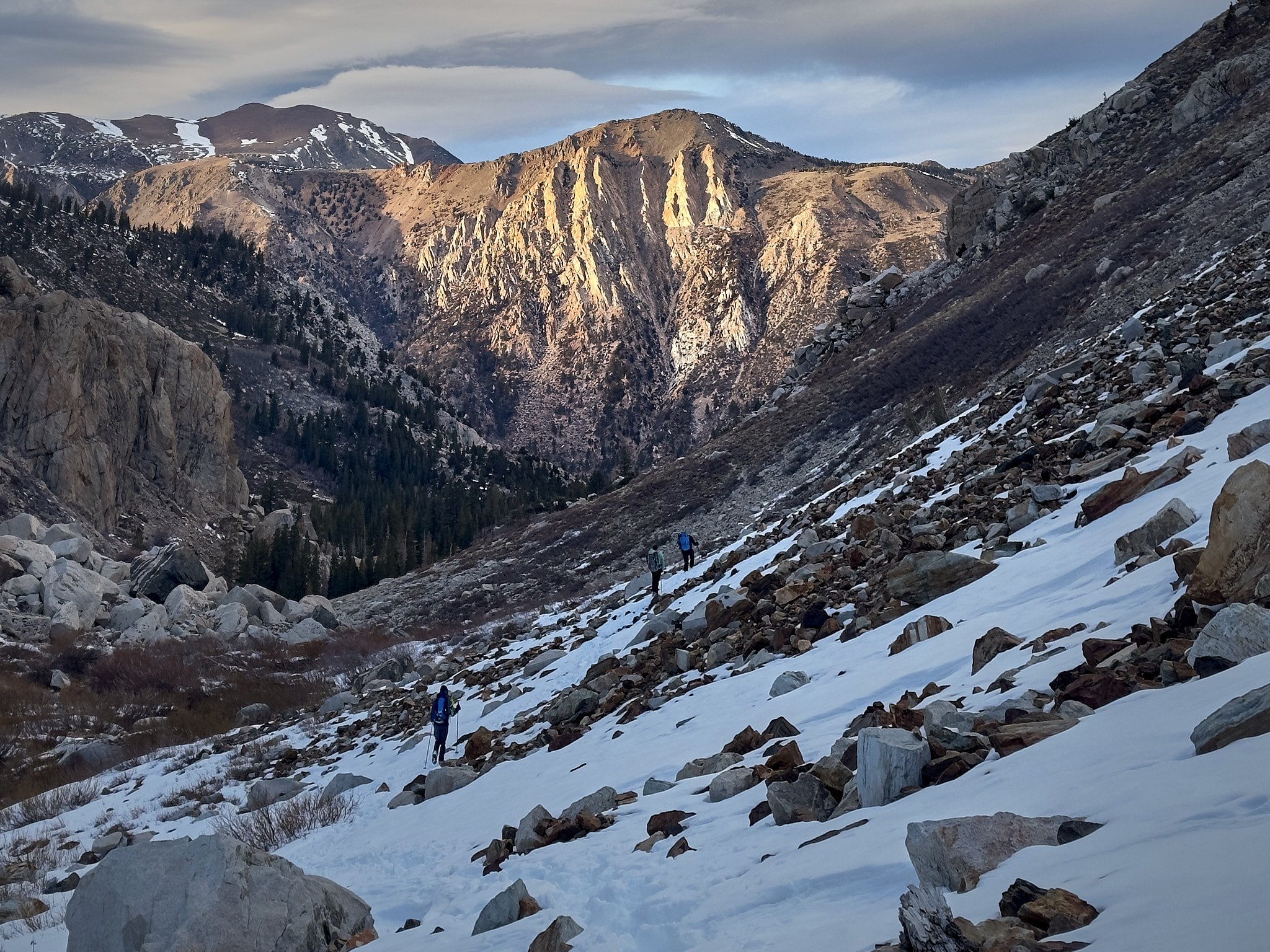
Soon we rose out of the gully and skirted the treeline. A bleed of pastel sunlight brushed the range ahead. At last we glimpsed it, Matterhorn Peak—a buttressed pinnacle of granite embattled by chutes of scree and the frequent rockfall loosed by snowstorms. The cold turned bitter as clouds rolled in, prematurely blotting the horizon. There had been grumblings of a low pressure system, but it was not due until that evening.
Scrambling onto a narrow outcrop, we unslung our packs and made immediate use of the longstanding convention in mountaineering that no downtime go unclaimed by the ingestion of food or beverage. Above us, a high angle slope unfolded into a sort-of saddle. I tried to take its measure but with no reference points found it impossible to do so. As we slouched against the boulders, surveying the dizzying slant of snow, morale diminished considerably. In three hours of strenuous cross-country travel we had covered less than a mile. This was shamefully inefficient. I have seen lines at the DMV move faster. Our backs and knees complained, as did our mouths. It must be said, in all, there was a flaccid air about us.
It did not help any that Varun and Rose had turned around. Varun’s pace had flagged increasingly and, for reasons known only to them, Rose was obliged to match him step for step. The rockfall soon overwhelmed them, and they descended back to camp.
In all fairness, there was not one among us who did not struggle with their balance. It was not the rocks alone that hindered us, but our so-called mountaineering boots, which were in fact two pairs of boots, one nested in the other, so impossibly thick that no tactile sensation could penetrate them. They did a perfectly commendable job of replicating having your legs cast in cement.
Add to this a further complication, one which I have heard irreverently referred to as “dust on crust.” That is to say, a serene layer of snowfall that obscures the all-too-frequent plunge to hell. Snow draped across each nook and cranny and served to homogenize the talus so that the climber could rarely tell a foothold from a fractured ankle.
As we resumed our lifeless trundle, yet another charming detail was remarked on: Horse Creek, whose flow we had been tracing throughout the morning, was now nowhere to be seen. It had ducked out of sight, now rushing somewhere directly beneath us. Troubling, to say the least. Especially considering this was precisely how legendary Sierra ranger Randy Morgenson met his demise: by punching through the dust or crust, or whatever the hell you call it, to take the bath that has no end.
A word on “punching through.” This term covers a wide spectrum of calamity, ranging from the mere cracking of an outer surface to the far more dramatic plummet through layers of unconsolidated snow, which of course requires a laborious scramble back to the surface with every second step. To properly envision this peculiar brand of torment, imagine being dropped into an Olympic-sized pool that has been filled to the brim with confectioner’s sugar and told to swim a proper breast stroke.
The issue lay with facets. You see, on a microscopic level, snow can present either in rounds or facets, one of which adheres into a manageable surface, while the other resists consolidation and becomes impossible to move in. Granted, there are countless shades between these two extremes, as well as various states in which rounds and facets can exist concurrently on account of windslab, the density of snowpack, the relative level of ambient moisture, and about a zillion other confounding factors.
It was a staggering amount of information to process. And so we staggered. Our pace fell to a disgraceful shuffle and we took shifts in breaking trail, at last opting to diversify our torture by strapping on unmanageable snowshoes. At the base of a towering pitch, we cut switchbacks into the mountain and fell over ourselves, splay-legged and wailing. We resembled less a hardened band of mountaineers than an abandoned litter of teacup poodles.
In spite of all this, I retained the hope of summiting. I did not, however, retain my trekking poles. Instead, I snapped one cleanly in half while blundering against a submerged rock. I was now reduced to lurching with one hand extended, casting blindly about for purchase as though playing the child’s game of Marco Polo.
While it was not my proudest moment, neither was is my lowest. That arrived beside a frozen lake, positioned just below the saddle. We had regrouped there to pierce its rim with ice axes and refill our water bottles, and after doing so I took my gentlemanly leave to “attend to digestive matters.”
Plodding up a modest rise to where a screen of shrubs offered some privacy, I noticed with trepidation that even while in snowshoes I was repeatedly punching through. The snow was heavily faceted, and the effect only intensified while I was loosening my harness, unbuckling my pants, and struggling to squat over my snowshoes—a task which I soon learned was entirely impossible—so much so that, despite a flurry of last-minute efforts and a string of colorful expletives, I toppled headfirst into the snow.
A wet mask swung up to meet me. Both arms punched through to the shoulder. For an interminable moment I was held immobile, upended completely, painfully aware that if ever a climber were undeserving of alpine glory, it was the guy with his pants around his ankles and his bare moon to the sky.
From beneath the powdered crust, I could hear several voices laughing. Chief among them was the mountain.
◆ ◆ ◆
We never reached the summit.
Was I disappointed? Sure I was, but mainly with my own deficiencies. Would Ernest Shackleton have seen me pantless and capsized in the snow and asked me to serve aboard The Endurance? Or Colin Fletcher have invited me on some far-flung expedition? Or Sigurd Olson, or Patrick Leigh Fermor, or Mary Austin, for that matter? They were each great for a reason, because they emulated no one.
During the hike back to camp, I decided it was high time for a career change. My winter mountaineering was not a failure, I understood that, for no failure could be so exhaustive, nor so profitably humbling. But neither was it a triumph. That much at least was certain.
I would now, I supposed, return home to assume my rightful position in the annals of exploration as enthusiastic spectator. There was little hope that someone as old and profoundly inexperienced as I could make an impression on the proud mosaic of mountaineering.
Little hope, perhaps. But little was more than none.
True to form, by the time I limped back through the windbreak I was once more awash in visions of daring traverses and heroic first ascents. Varun and Rose welcomed us warmly and hot cocoa was circulated. We sat in a tight knot and offered accounts of our day in pithy, well-turned remarks.
Juan laughed, “Eso fue carrete.”
Vic said, “I’m moving to the desert.”
My contribution was, if memory serves me correctly, a guttural and heartfelt “…rrgggh.” I had just discovered a group of muscles locked in spasm along my groin. I writhed in elaborate agony and swore off mountaineering forever
I’ll stop here. I could go on recounting the predictable cycle of indignity and aspiration which formed a reliable, if not exactly comforting, motif to my endeavors. Suffice to say that passion is both a virtue and disservice. And that hope can as easily deliver transcendence as a swift kick to the head.
The trick is telling one from the other.
As printed in The Sierra Echo

About the Author
A writer by trade, Isaac Simons is a longtime lover of outdoor exploration and has devoted himself increasingly to introducing as many people as possible to the challenges and rewards of the backcountry. His writing has appeared in Storgy Magazine, Centipede Press and Viewfinder Magazine, among others, with pieces forthcoming in Summit Journal and LOST. Most recently, Isaac launched Outroads, a video podcast about uncommon obsessions, unconventional life choices, and the lessons gleaned from them.